
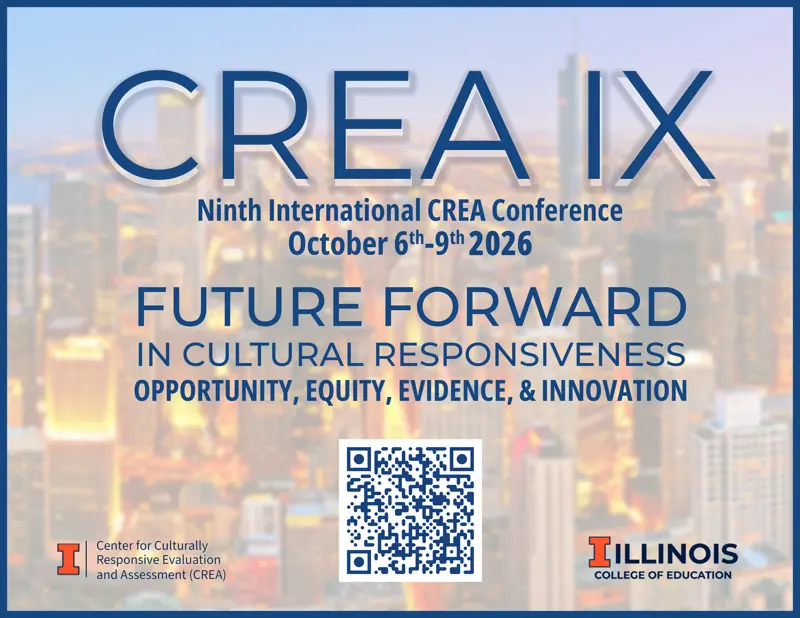
Ninth CREA International Conference
CREA IX | October 6-9, 2026 | Chicago, IL
Conference Theme
Future-Forward in Cultural Responsiveness: Opportunity, Equity, Evidence, and Innovation
For this year’s CREA IX conference, we are addressing:
Uncertainty and possibility.
Acceleration and disruption.
Innovation and inequity.
Promise and precarity.
As evaluators, scholars, practitioners, and community members, we are navigating a world marked by seismic change and accelerating injustice. The conditions shaping our work demand more than typical reactions. They require intentionality in how evaluation, assessment, and research respond to the present while shaping what is positively possible for the future. CREA IX builds on our collective commitments to care, healing, and relational responsibility by advancing an orientation of future-forward cultural responsiveness. This orientation calls for anticipating emerging challenges, engaging evolving contexts, and designing inquiry practices that contribute to more just, equitable, and sustainable futures. Future-forward cultural responsiveness calls us to consider not only what is, but also what can be and what must be different.
Opportunity: Opportunity is not neutral. It is shaped by systems, decisions, and values.
Equity: Equity is not a destination. It is a sustained and active practice.
Evidence: Evidence does not simply describe the world. It shapes decisions, narratives, and futures.
Innovation: Innovation requires both imagination and accountability.
Moving Forward Together
Future-forward cultural responsiveness invites us to hold multiple tensions, including urgency and reflection, rigor and flexibility, and tradition and emergence. It calls us to work across disciplinary, geographic, generational, and methodological boundaries while remaining grounded in culturally responsive practice. As a global community of evaluators, educators, researchers, practitioners, and scholars, we are tasked with shaping evaluation and inquiry practices that not only respond to inequities but also actively contribute to more just and equitable opportunity-based futures.
Prices
- Early-bird Registration: $500 (ended 7/31)
- Regular Registration: $650
- Student Registration: $350
- Single Day Registration: $300
- Half-day Workshops: $200
- Full-day Workshops: $400
Contact Tim Leyhe with student ID to get a student discount code.
Session Formats
All proposals should detail the presentation's focus and the way(s) in which it contributes to the body of knowledge in culturally responsive evaluation and assessment and reflects the conference theme. Proposals shorter than 250 words or longer than 500 words will not be reviewed.
Paper
Paper presentations are individual submissions (with one or multiple authors). In paper sessions, authors present abbreviated versions of their papers. Session chairs then invite comments, critiques, and audience discussion. Accepted papers will be grouped on a common theme and allocated 15 minutes for a 45- or 90-minute session. A session chair will be appointed by the conference committee. A typical structure for a session with three or four papers allows approximately 5 minutes for the chair’s introduction to the session, 15 minutes per author presentation, 10 minutes of critique, and 15 minutes of discussion.
Roundtable Session
Roundtable sessions offer maximum interaction among presenters and attendees. Roundtables are 45-minute oral presentations and discussion with attendees seated around a table. Roundtable sessions typically include 15 minutes of presentation, followed by 30 minutes of discussion and feedback. Roundtable presenters bring targeted questions to generate conversation and critical exchange among those attending. Roundtables are ideal for networking and in-depth discussion on a particular topic. Because of this type of session's physical configuration, no additional audiovisual equipment, such as a screen or LCD projector, is provided. Authors wishing to display information may do so from their laptop computer screens. If you plan to use a laptop, please be sure the battery is charged, as a power source may not be provided.
Symposium
A symposium examines specific research issues, problems, or topics from various perspectives. Proposals should include the name(s) of a chair and discussant plus descriptions of each presentation. Symposia may present alternative solutions, interpretations, or contrasting points of view on a specified subject or in relation to a common theme. Symposia may also use a panel discussion format targeted at a clearly delineated research issue or idea. Symposia may be quite interactive: A large portion of the session may be devoted to activities such as discussion among the presenters and discussants, questions and discussion among all those present at the session, or small-group interaction. Innovative formats (e. g., town hall) can be proposed under this rubric.
Symposia will be assigned either a 45-minute slot (for two presentations) or a 90-minute slot (for more than two presentations). Session submissions for symposia are limited to five (5) participants for 90-minute sessions, inclusive of presenters, and discussant(s). These limits are in addition to the session chair. The proposer should allocate time among the multiple papers to ensure an opportunity for audience questions. Proposals for a symposium are limited to 250 words for a session summary and 250 words for each paper included within the symposium. No more than 4 papers can be submitted for a single symposium. Symposium proposals are reviewed as a whole, and the full proposal will be accepted or rejected.
General Conference Schedule
Tuesday, October 6: Pre-Conference Workshops
- Full Day Sessions (9:00am - 5:00pm)
- AM Half Day Sessions - 8:00am - 12:00pm)
- PM Half Day Sessions - 1:00pm - 5:00pm)
Wednesday, October 7th
- Pre-Conference Workshops (8:00am - 12:00pm)
- Opening Ceremony and Keynote Speaker
- Conference Sessions
Thursday, October 8th
- Morning Plenary
- Edmund W. Gordon Senior Distinguished Lecture and Luncheon
- Conference Sessions
Friday, October 9th
- Conference Sessions
- Luncheon & Keynote Speaker
- Closing Ceremony